
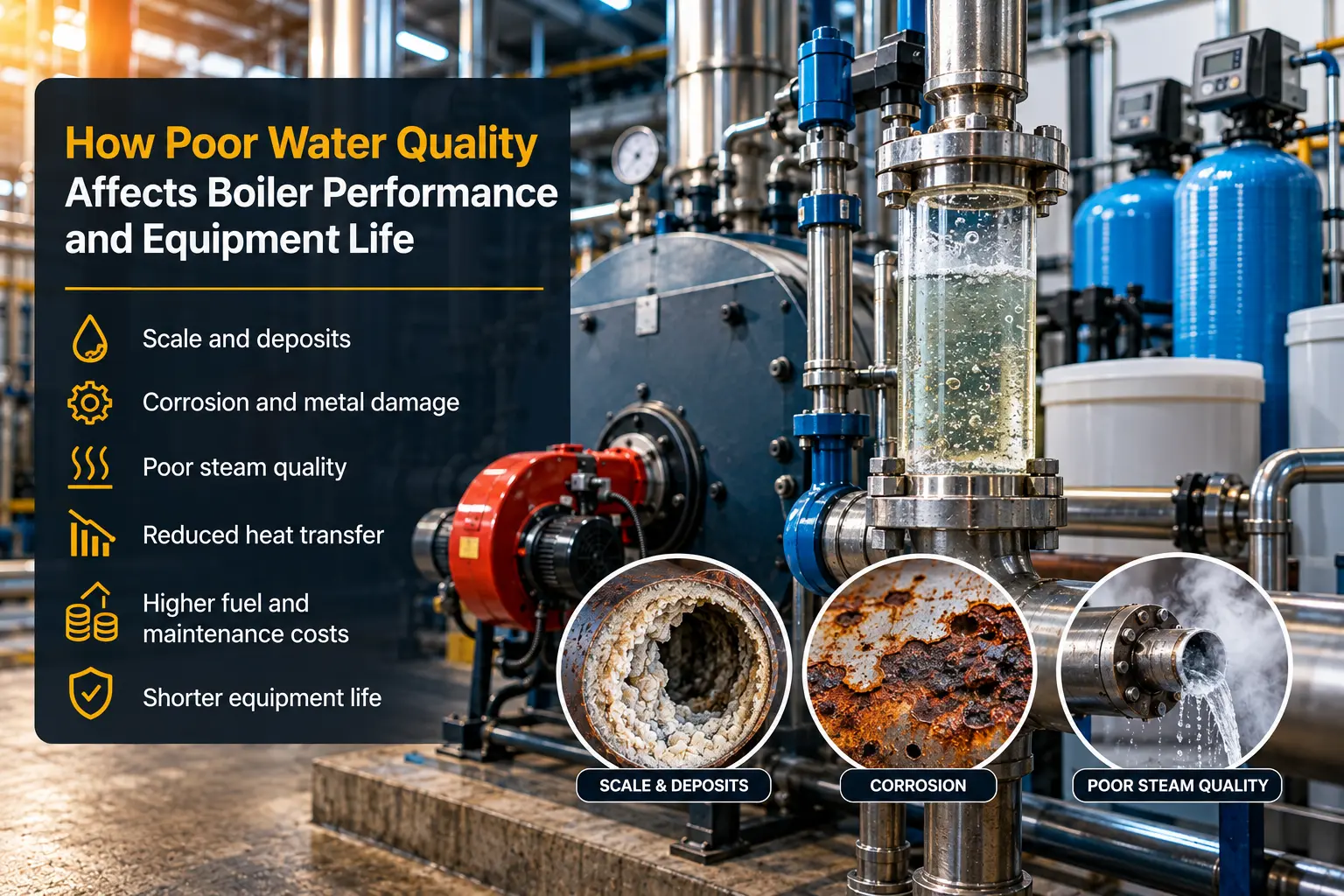
Boiler Water Is Part of the Boiler's Performance System
When boiler performance starts changing, attention often goes first to the burner. Is combustion correct? Is fuel pressure stable? Has stack temperature increased? Those are important questions, but the condition of the water inside the boiler can be just as important.
A boiler is fundamentally a heat-transfer system. Heat produced by combustion must pass through metal heating surfaces into water to generate steam. Conditions on both sides matter:
Combustion Side → Heating Surface → Water Side → Steam
If the combustion side is performing well but waterside surfaces become covered with deposits, heat transfer can deteriorate. If water chemistry encourages corrosion, the equipment itself can be damaged. If dissolved solids become excessively concentrated, steam quality can also be affected.
Boiler-water treatment should not be viewed as a separate utility activity. It is part of boiler performance, reliability and equipment protection.
Engineering Principle: Good boiler-water treatment is not only about preventing scale. It is about maintaining water conditions that support effective heat transfer, reliable steam production and long-term equipment protection.
1. Why Water Quality Matters to Boiler Performance
Water entering a boiler is not simply heated and discharged. Steam leaves the boiler, but many dissolved substances entering with the feedwater remain behind. As steam production continues, those substances can become increasingly concentrated unless they are controlled through appropriate pretreatment, chemical treatment and blowdown.
Deposits
Minerals and other contaminants can accumulate on heat-transfer surfaces.
Scale
Certain deposits can form hard insulating layers on boiler tubes and other heated surfaces.
Corrosion
Unsuitable water chemistry, dissolved gases and contaminants can attack boiler metal.
Carryover
Boiler water and its impurities can become entrained with steam and enter the downstream steam system.
These are different problems, but they share an important connection: the quality and control of the water entering and circulating within the boiler matter to the performance of the entire steam system.
2. What Happens When Boiler Water Is Not Properly Controlled?
Poor Makeup-Water / Feedwater Conditions → Inadequate Pretreatment or Chemistry Control → Scale / Deposits / Corrosion / High Dissolved Solids → Heat-Transfer or Steam-Quality Problems → Higher Fuel or Maintenance Requirements → Potential Equipment Damage / Reliability Problems
Hardness entering the boiler may contribute to scale formation. Dissolved oxygen can contribute to corrosion. Excessive concentration of dissolved solids can increase the risk of foaming and carryover. Contaminants returning through condensate can introduce different problems.
“The boiler has a water problem” is not a diagnosis. The next question should be:
Which water condition is outside the intended operating program, and what effect is it having?
3. Scale and Deposits Reduce Heat Transfer
Scale is one of the clearest connections between water quality and boiler efficiency.
Under clean conditions:
Hot Combustion Gas → Boiler Metal → Boiler Water
When scale develops:
Hot Combustion Gas → Boiler Metal → Scale → Boiler Water
Scale becomes an additional thermal barrier. Possible consequences include increased fuel requirements, higher tube-metal temperatures, reduced heat-transfer effectiveness, additional cleaning requirements, increased maintenance and tube reliability problems.
Scale does not automatically cause every increase in fuel consumption. Similar symptoms can also result from fireside fouling, combustion changes, excess air, burner problems, feedwater-temperature changes, load changes or other operating conditions.
Diagnosis should come from operating data + water-treatment history + physical inspection.
For a deeper explanation of the heat-transfer mechanism, see Why Boiler Scale Increases Fuel Consumption and Maintenance Costs.
Engineering Note: Finding scale is evidence that a deposit formed. It does not automatically identify the chemistry or operating condition that caused it.
4. Corrosion Can Damage Boiler Components
Not every water-quality problem creates scale. Some water conditions attack the metal itself. Dissolved oxygen and unsuitable water chemistry can contribute to corrosion, potentially affecting boiler tubes, feedwater systems, condensate piping, deaerator/feedtank systems, and steam and condensate components.
Potential contributors may include dissolved oxygen, unsuitable pH, carbon dioxide in condensate systems, contamination, inadequate treatment, poor deaeration and improper shutdown or storage practices. No one condition automatically proves the corrosion mechanism; the actual mechanism should be investigated.
Engineering Principle: Water treatment has two different jobs that are sometimes discussed as though they were one: control deposits and control corrosion. A program that addresses only one may still leave the boiler vulnerable to the other.
5. Poor Water Quality Can Affect Steam Quality
As steam forms, impurities that do not leave with the steam become concentrated in the boiler water. Under unfavorable conditions, boiler water and contaminants can enter the steam system. Possible downstream effects can involve control valves, heat exchangers, steam traps, steam piping and process equipment. Carryover can also contribute to wet-steam conditions.
Carryover is not caused only by water chemistry. Other operating contributors may include excessive boiler-water level, rapid changes in steam demand, operating conditions, foaming and contamination.
A steam-quality problem should therefore be investigated as a system condition, rather than automatically treated as a chemical-treatment problem.
6. How Blowdown and Dissolved Solids Fit Into the Picture
Dissolved substances remain behind as steam is generated, causing concentration to increase. Blowdown removes a controlled quantity of boiler water to manage concentration.
Too Little Blowdown
May contribute to deposits, sludge accumulation, foaming and carryover.
Too Much Blowdown
Can waste heat, water and treatment chemicals.
The objective is not “increase blowdown” and not “reduce blowdown.” The objective is to maintain appropriate boiler-water concentration according to the boiler and its established treatment program.
Engineering Note: Blowdown is a control mechanism, not a universal cure for poor water quality. If unsuitable water is continually entering the boiler, increasing blowdown alone may not correct the underlying problem.
7. The Role of Makeup Water, Softening and Pretreatment
The easiest contaminant to manage inside a boiler is often the one that never enters it.
Pretreatment requirements depend on raw-water quality, boiler pressure, boiler design, percentage of makeup water, condensate return, steam-system requirements and the existing treatment program.
Filtration
Used where suspended material needs to be controlled before downstream treatment.
Water Softening
Softening is commonly used to reduce calcium and magnesium hardness that can contribute to scale. Installing a softener is not enough; its actual output should be verified. Possible problems include hardness breakthrough, incorrect regeneration, brine-system problems, resin deterioration, excessive flow and incorrect operating settings.
Reverse Osmosis
Where appropriate, reverse osmosis can reduce a broader range of dissolved substances entering the boiler system.
Demineralization
Some applications require more extensive removal of dissolved ions.
Deaeration
Dissolved gases, particularly oxygen, must also be considered as part of corrosion control.
The correct combination depends on the actual system. There is no universal pretreatment arrangement suitable for every boiler.
8. What Water Parameters Should Maintenance Teams Monitor?
| Parameter / Condition | Why It Matters |
|---|---|
| Raw/makeup-water quality | Establishes what the treatment system must handle |
| Makeup-water hardness | Indicates scale-forming potential entering pretreatment |
| Softener outlet hardness | Helps verify softener performance |
| Feedwater temperature | Affects boiler energy requirements and treatment conditions |
| Feedwater chemistry | Helps assess water entering the boiler |
| Boiler-water pH | Important to the established corrosion/treatment program |
| Conductivity / TDS indicator | Helps assess concentration where applicable |
| Treatment chemical residuals | Helps verify the established chemical program |
| Blowdown condition/rate | Helps understand concentration control |
| Condensate-return quality | Can reveal contamination or corrosion issues |
| Makeup-water quantity | Helps identify changes in system water balance |
| Waterside condition | Provides physical evidence of deposits or corrosion |
This table is not a universal specification. Acceptable limits vary according to boiler pressure, boiler manufacturer requirements, treatment chemistry, system design, steam use and water source. Actual control limits should follow the treatment provider, boiler manufacturer and applicable requirements.
Trend the Results
Individual tests are useful. Trends are more useful.
If softener outlet hardness is normally controlled and then repeatedly appears, maintenance should investigate before waiting for boiler deposits to reveal the problem. A gradual change in makeup-water consumption may indicate changes elsewhere in the steam/condensate system.
9. Warning Signs of a Developing Water-Quality Problem
Potential warning signs include:
- Repeated hardness breakthrough
- Increasing waterside deposits
- Recurring scale after cleaning
- Unexpected corrosion
- Changing boiler-water chemistry
- Increasing blowdown requirements
- Foaming or carryover
- Wet-steam symptoms
- Contaminated steam-system equipment
- Rising fuel consumption under comparable steam demand
- Increasing stack temperature under comparable conditions
- Repeated tube problems
- Changes in condensate-return quality
- Increased makeup-water consumption
None of these observations alone identifies the root cause. Higher fuel consumption may result from scale, but it could also result from combustion deterioration. Tube damage may involve water chemistry, but the actual failure mechanism needs to be established. Carryover may involve high dissolved solids, but boiler level and load changes may also contribute.
Water Data + Operating Data + Maintenance History + Physical Evidence
Water quality is one of the areas that should be considered when assessing overall boiler condition. See What Should Be Checked During a Boiler Performance Audit? for how water-treatment information fits alongside fuel consumption, steam output, combustion, stack temperature, controls and historical trends.
10. How Better Water Management Supports Boiler Life
1. Understand the Incoming Water
Know what the facility's raw or makeup water contains and monitor meaningful changes.
2. Verify Pretreatment Performance
Do not assume treatment equipment is performing correctly because it is running. Test its actual output.
3. Maintain the Established Chemistry Program
Chemical treatment should be controlled according to the boiler, water conditions and qualified treatment program.
4. Control Blowdown Properly
Maintain the intended concentration without unnecessarily wasting hot treated water.
5. Protect the Condensate System
Returned condensate is valuable because it retains heat and can reduce makeup-water requirements, but its quality should also be monitored where contamination is possible.
6. Inspect Waterside Surfaces
During appropriate planned shutdowns, inspect for scale, sludge, corrosion, localized deposits, pitting and abnormal tube conditions.
7. Connect Water Data With Boiler Performance
Compare chemistry and water data with fuel consumption, steam production, stack temperature, boiler load and maintenance events.
8. Investigate the Root Cause
If scale, corrosion or carryover appears, ask why. Cleaning a deposit without correcting its cause may simply allow it to return.
Don't Treat Water Treatment as a Separate Utility
Different facility teams may separately monitor steam, chemistry, maintenance and costs, but these are physically connected.
Water Quality → Deposit & Corrosion Control → Heat Transfer → Steam Generation → Fuel Consumption → Maintenance & Reliability
Water-treatment records become more valuable when evaluated alongside boiler-performance data. Boiler-performance data becomes more useful when the condition of the water side is understood.
When Should Boiler Water Conditions Be Investigated?
Investigation may be appropriate when scale repeatedly returns after cleaning, softener performance becomes inconsistent, water chemistry moves outside the established treatment program, makeup-water conditions change, condensate contamination is suspected, corrosion or pitting is discovered, carryover becomes evident, blowdown requirements change unexpectedly, fuel consumption rises under comparable steam demand, tube problems recur or the facility lacks consistent water-quality records.
The objective is not to assume water treatment is responsible for every boiler problem. It is to determine whether the water side of the system is operating within its intended conditions.
The Key Question
The wrong question is:
Do we have a water-treatment system?
A facility may have a softener, chemical dosing, blowdown and water testing and still experience water-related problems if those systems are not producing the intended conditions.
The better question is:
Is the water entering and circulating through the boiler consistently within the conditions required for this system?
That requires measurement. It requires trends. It requires inspection. And when a problem appears, it requires understanding the cause rather than simply treating the symptom.
Concerned About Your Boiler Water Quality?
If your facility is experiencing recurring scale, changing water conditions, corrosion, carryover or unexplained changes in boiler performance, the water side should be evaluated together with the boiler's operating data.
Aali Services supports industrial facilities with:
- Water-treatment systems
- Boiler inspection and maintenance
- Boiler performance assessment
- Water-treatment condition review
- Preventive maintenance
- Boiler troubleshooting