
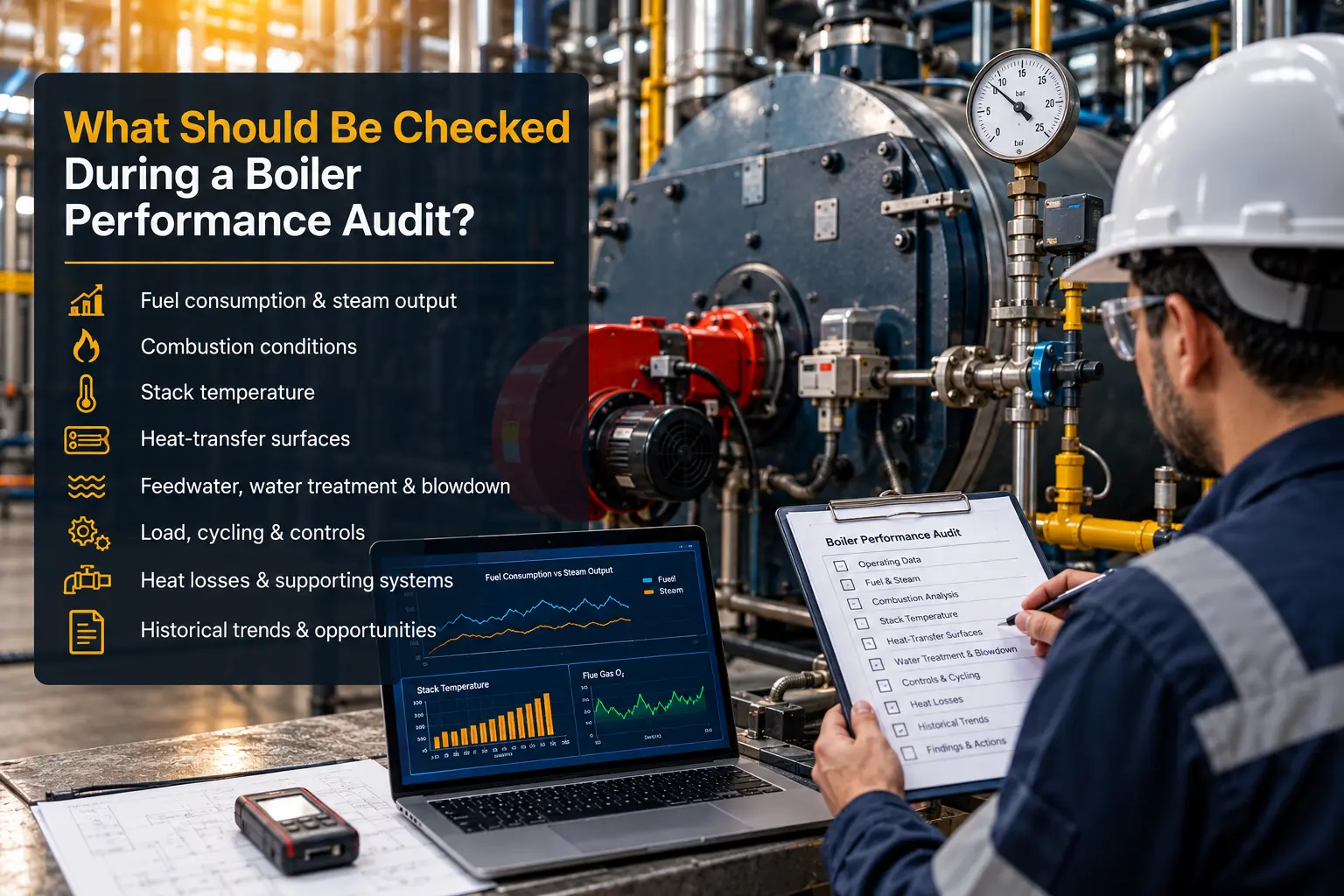
A boiler performance audit should look beyond whether the boiler is simply producing steam. It should examine how efficiently the boiler converts fuel into useful steam, how combustion and heat transfer are performing, and whether operating trends indicate opportunities for improvement.
A Boiler Can Be Running Normally and Still Deserve Investigation
A boiler performance audit should not begin with the assumption that something is wrong. It should begin with a question:
How is this boiler actually performing under its current operating conditions?
A boiler may start correctly, maintain steam pressure and satisfy production demand. Operators may not be reporting any obvious problems. But none of those observations alone tells us how effectively fuel is being converted into useful steam.
A boiler may still be operating while:
- Fuel consumption has gradually increased
- Excess air has moved away from an appropriate operating range
- Stack temperature has changed
- Heat-transfer surfaces have become fouled
- Blowdown conditions have changed
- Feedwater conditions have deteriorated
- Short cycling has increased
- Steam demand and boiler capacity are poorly matched
A useful performance audit therefore looks at the boiler as an operating system, not simply as a piece of equipment that is either running or stopped.
1. Start With the Boiler's Operating Baseline
Before interpreting measurements, the auditor needs context. Two boilers with similar capacities may operate very differently because of fuel type, boiler design, operating pressure, steam demand, production schedule, burner configuration, feedwater temperature, condensate return, boiler load, water-treatment conditions and maintenance history.
That means the first stage of an audit should establish what is normal for the specific boiler being assessed.
| Information | Why It Matters |
|---|---|
| Boiler make/model and capacity | Establishes equipment context |
| Fuel type | Affects combustion and performance analysis |
| Operating pressure | Helps define normal operating conditions |
| Typical steam demand | Provides context for boiler loading |
| Operating hours | Helps evaluate fuel and maintenance history |
| Fuel-consumption records | Provides an energy-input trend |
| Steam-production records | Provides useful-output data |
| Feedwater temperature | Influences boiler energy requirements |
| Makeup-water usage | Helps understand system water balance |
| Maintenance history | Identifies recurring operating issues |
| Previous combustion reports | Provides historical comparison |
| Water-treatment records | Helps identify changing waterside conditions |
The goal is not simply to collect documents. It is to establish a reference against which current measurements can be interpreted.
Engineering Principle: A measurement becomes much more useful when you know what the boiler normally does under comparable operating conditions.
2. Compare Fuel Consumption With Steam Output
One of the most important relationships in a boiler performance audit is:
Fuel Input → Useful Steam Output
Fuel consumption by itself does not tell the whole story. A boiler consuming more fuel may simply be producing more steam. Likewise, a lower daily fuel bill does not necessarily mean the boiler has become more efficient if production demand also fell.
A more meaningful question is:
How much fuel is being used to produce the required steam under comparable conditions?
Where reliable metering exists, an audit should review fuel consumption, steam production, boiler load, operating hours, feedwater conditions and production demand. These should be compared over appropriate periods rather than viewed as isolated totals.
If steam production is broadly unchanged but fuel consumption has gradually increased, something may deserve investigation. Possible contributors could include combustion changes, waterside scale, fireside fouling, increased blowdown, reduced feedwater temperature, heat losses, burner deterioration or different operating/load patterns.
Important Distinction: The observation identifies a performance change. It does not, by itself, identify the cause.
3. Check Combustion Conditions
Combustion is a central part of boiler performance. The burner must provide enough air for effective combustion, but unnecessary excess air can carry additional heat out through the stack.
Depending on the boiler, fuel and available instrumentation, combustion checks may include:
- Flue-gas O2
- CO
- CO2 where applicable
- Stack temperature
- Combustion-air temperature
- Burner firing condition
- Fuel pressure and condition
- Draft conditions
- Flame condition
- Burner modulation
Combustion readings should be associated with boiler load. Where it is safe and practical to do so, consider low fire, mid fire and high fire rather than relying on a single point.
Engineering Note: The objective is not simply to obtain the lowest possible oxygen reading. Combustion must remain stable, appropriate for the burner and fuel, and within applicable manufacturer, safety and emissions requirements.
4. Review Stack Temperature
Stack temperature provides useful information about what is happening to heat after combustion. If more heat leaves through the stack, less of that energy is available for useful boiler output.
However, stack temperature should never be interpreted completely by itself. It can be influenced by boiler load, excess air, combustion-air temperature, fuel, fireside fouling, waterside deposits, economizer performance and boiler design.
Consider two readings:
- Reading A: Stack temperature = X
- Reading B: Stack temperature = X + 25°C
Without boiler load, excess oxygen, ambient conditions and other operating parameters, this difference is difficult to interpret.
If under comparable conditions steam demand is similar, boiler load is similar, O2 is comparable, fuel is unchanged, and stack temperature is consistently increasing, then the trend deserves investigation.
5. Inspect Heat-Transfer Surfaces
Good combustion does not guarantee good overall boiler performance. Heat still needs to move effectively from combustion gases through boiler heating surfaces and into the water.
Fireside Condition
Possible issues include soot, ash, deposits, fouling, damaged refractory and evidence of abnormal combustion.
Waterside Condition
Possible issues include scale, sludge, deposits, corrosion and localized abnormal conditions. We covered the relationship between waterside deposits, heat transfer and fuel consumption in more detail in Why Boiler Scale Increases Fuel Consumption and Maintenance Costs.
Important Distinction: An operating performance audit does not require opening a boiler while it is in service. Internal inspection should only be performed under the appropriate shutdown, isolation and safety procedures.
6. Review Feedwater, Water Treatment and Blowdown
Boiler efficiency is not only a combustion issue. Useful information may include feedwater temperature, makeup-water quantity, condensate-return conditions, softener performance, makeup-water hardness, boiler-water chemistry, conductivity/TDS indicators where applicable, blowdown practice and evidence of recurring scale or sludge.
Feedwater Temperature
Properly heated feedwater and recovered condensate can reduce additional boiler energy requirements compared with colder makeup water. Review feedwater temperature alongside condensate return and makeup-water conditions.
Blowdown
Too little blowdown can contribute to deposits or carryover. Excessive blowdown wastes water, energy and treatment chemicals. The objective is proper blowdown control, not simply maximizing or minimizing blowdown.
Water Treatment
Water-treatment performance should be reviewed because scale and corrosion can affect reliability as well as heat transfer. Review treatment readings and operating records in the context of the boiler's treatment program.
7. Check Boiler Load, Cycling and Controls
A boiler can be mechanically sound but operating inefficiently because of how it is being used. Questions should include:
- At what percentage of capacity does the boiler normally operate?
- How often does the burner start and stop?
- Does the burner modulate smoothly?
- Is the boiler frequently operating at very low load?
- Does steam demand fluctuate sharply?
- Is more boiler capacity online than the facility currently requires?
Frequent short cycling can introduce avoidable losses. Depending on the boiler, review burner modulation, fuel/air control, pressure-control behavior, sequencing between multiple boilers, O2 trim where installed, alarm history, repeated burner starts and operating setpoints.
The question is not simply:
Are the controls working?
It is:
Are the controls allowing the boiler to operate appropriately for the actual load?
8. Review Heat Losses and Supporting Systems
Not every performance opportunity exists inside the boiler.
Boiler Insulation and Refractory
Look for damaged insulation, refractory or lagging.
Steam and Condensate Piping
Look for damaged or missing insulation, visible steam leaks, condensate leaks, abnormal hot surfaces, and poorly insulated valves and fittings.
Steam Traps
Failed steam traps can waste steam or interfere with condensate removal.
Condensate Return
Poor condensate recovery can increase makeup-water demand, water-treatment requirements and heating requirements for incoming water.
Economizer
Where installed, consider economizer condition and performance because it can recover useful flue-gas energy to heat incoming feedwater.
9. Compare Current Performance With Historical Trends
Engineering Principle: A single combustion test provides information about the boiler at that moment. Historical data tells us whether performance is changing.
| Trend | What It Can Help Reveal |
|---|---|
| Fuel consumption vs steam output | Changes in overall fuel-to-steam performance |
| Stack temperature vs boiler load | Possible changes in heat transfer or operating conditions |
| O2 vs firing rate | Changes in combustion behavior |
| Feedwater temperature | Changes affecting boiler energy demand |
| Makeup-water consumption | Changes in condensate return or system losses |
| Blowdown | Changes in water/energy loss |
| Burner starts | Increasing cycling |
| Maintenance events | Recurring equipment problems |
| Water-treatment readings | Developing waterside conditions |
Consider this example:
- Six months ago: Lower fuel per unit of steam
- Three months ago: Stack temperature began rising
- Today: Fuel consumption is higher under comparable load
Instead of asking, “Is today's reading acceptable?”, ask:
Why is the boiler moving away from its historical baseline?
10. Turn Audit Findings Into Actions
An audit should not end with a long list of measurements. Findings can be grouped by the next appropriate step.
No Immediate Action
The parameter appears consistent with expected operation and historical performance.
Monitor
Something has changed, but there is not yet enough evidence to justify corrective work.
Investigate
Operating data suggests a meaningful change that deserves further technical assessment.
Maintenance Opportunity
Examples may include fouled surfaces, damaged insulation or burner maintenance requirements.
Optimization Opportunity
Examples may include controls, excess air, blowdown, condensate recovery and operating strategy.
Requires Specialist / Safety Assessment
Any condition involving safety controls, pressure-containing components, combustion safety, structural integrity or regulatory compliance should be handled under the appropriate specialist and statutory procedures.
Engineering Principle: A good audit does not force every observation into a diagnosis. It separates what is known, what the data suggests, and what requires further investigation.
What Should a Boiler Performance Audit Record?
| Area | Typical Information |
|---|---|
| Boiler | Make/model, capacity, fuel, pressure |
| Operating condition | Load, steam demand, operating status |
| Fuel | Type, consumption/rate where available |
| Steam | Production/rate where metered |
| Combustion | O2, CO, stack temperature and relevant observations |
| Feedwater | Temperature and relevant water conditions |
| Blowdown | Current practice/rate where measurable |
| Heat transfer | Fireside/waterside condition where inspectable |
| Controls | Cycling, modulation, setpoints |
| Heat loss | Insulation/refractory observations |
| History | Previous readings, fuel/steam trends, maintenance |
| Findings | Observations and evidence |
| Actions | Monitor, investigate, maintain or optimize |
The exact audit should be adapted to the boiler and facility. Not every plant will have every meter, and that itself can be an audit finding. If fuel input or steam output cannot be measured reliably, establishing meaningful boiler performance trends becomes more difficult.
A Performance Audit Is Not a Safety Inspection
A boiler performance audit focuses on operating performance, energy use, heat transfer, combustion, waterside conditions and opportunities for improvement.
A statutory or safety inspection deals with areas such as pressure integrity, safety devices, regulatory compliance and jurisdiction-specific requirements.
One does not replace the other.
A boiler appearing efficient still requires all applicable safety inspections and maintenance. Passing a statutory inspection also does not necessarily mean the boiler is operating at its best achievable performance.
When Is a Boiler Performance Audit Worth Considering?
A performance audit may be worth considering when:
- Fuel consumption has increased without an obvious production change
- Stack temperature is trending upward
- Combustion readings have changed
- Boiler cycling has increased
- Scale or fireside deposits are recurring
- Steam demand has changed significantly
- Water-treatment conditions have changed
- The boiler has recently undergone major maintenance
- Management wants a baseline before an efficiency-improvement program
- There is limited historical information about actual boiler performance
A performance audit can also be useful when there is no obvious problem. Establishing a baseline while the boiler is operating well gives the maintenance team something valuable to compare against later.
The Key Question
A boiler performance audit should not simply answer:
Is the boiler working?
It should help answer:
How is the boiler performing, what has changed, and where should we investigate or improve?
Evaluating fuel consumption, steam output, boiler load, combustion, stack temperature, feedwater, water treatment, blowdown, heat-transfer surfaces, controls and operating history together gives a much clearer picture than any single measurement.
Want to Understand How Your Boiler Is Performing?
If your facility has rising fuel consumption, changing operating conditions, recurring deposits or simply lacks a reliable boiler-performance baseline, the first step is to understand the system using actual operating data.
Aali Services supports industrial facilities with:
- Boiler performance assessment
- Combustion and operating-condition review
- Boiler inspection and maintenance
- Water-treatment review
- Preventive maintenance
- Boiler troubleshooting