
Boiler Scale Is More Than a Water-Treatment Problem
A boiler does not necessarily stop producing steam when scale begins to develop.
That is one reason the problem can remain unnoticed.
The boiler may continue meeting plant steam demand while deposits gradually build on waterside heat-transfer surfaces. From an operating perspective, everything may initially appear normal.
But the question is not only:
Is the boiler producing steam?
The more useful question is:
How much fuel is now required to produce the same amount of steam?
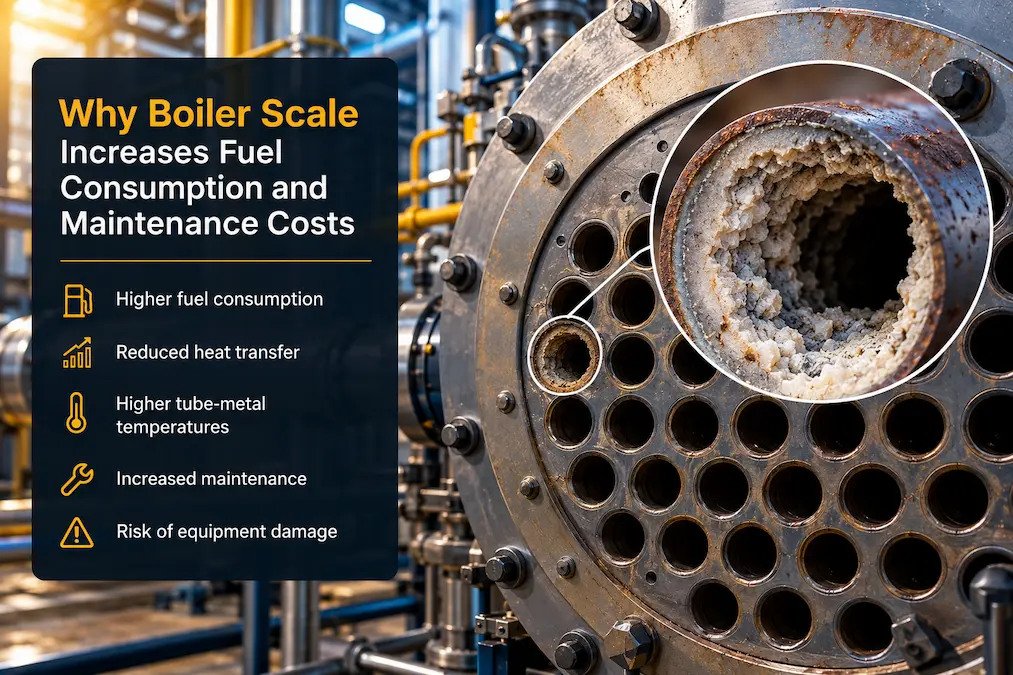
Scale can interfere with one of the boiler's most important functions: transferring heat efficiently from combustion into the boiler water. As that heat-transfer path becomes less effective, the consequences can extend beyond water treatment into fuel consumption, boiler efficiency, tube-metal temperature, maintenance requirements, equipment reliability and boiler availability.
Understanding this relationship begins with understanding what scale actually does inside a boiler.
1. What Is Boiler Scale?
Boiler scale is a deposit that forms on waterside heat-transfer surfaces.
Boiler feedwater can contain dissolved minerals and other substances. If water treatment, chemistry control or operating conditions allow certain constituents to become concentrated or precipitate, deposits can form on hot boiler surfaces.
Depending on the water source and treatment conditions, deposits may involve substances associated with:
- Calcium
- Magnesium
- Silica
- Iron
- Other dissolved or suspended contaminants
Not every boiler deposit has the same composition. That distinction matters: different deposits can have different thermal characteristics, which means their effect on heat transfer may also differ.
Maintenance teams should be careful about assuming the composition or severity of a deposit based only on appearance. Where necessary, water chemistry, treatment history and deposit analysis should be considered together.
2. How Scale Restricts Heat Transfer
A boiler depends on heat moving efficiently through its heating surfaces. In simplified form:
Combustion → Metal Heating Surface → Boiler Water → Steam
When the waterside surface is clean, heat can move through the metal into the boiler water relatively efficiently. Scale adds another layer:
Combustion → Metal → Scale Deposit → Boiler Water
That deposit can act as thermal insulation. The heat now has an additional barrier to cross before reaching the water. As scale becomes more significant, heat transfer can become less effective.
This is the fundamental reason scale can affect both boiler efficiency and equipment reliability.
3. Why Scale Can Increase Fuel Consumption
Consider a boiler operating under relatively stable production conditions. Historically, it produces a certain amount of steam using a certain amount of fuel. Over time, waterside deposits begin forming.
If those deposits reduce heat-transfer effectiveness, maintaining the required steam production may require additional fuel input. The plant still gets its steam, but the energy required to produce that steam may increase.
This is why simply looking at whether the boiler is running can hide an efficiency problem. A more useful comparison is fuel input versus steam output.
For example, imagine that over several months:
- Steam demand remains broadly similar
- Boiler load remains comparable
- Fuel type remains unchanged
- Fuel consumption gradually increases
- Stack temperature also trends upward
That does not automatically prove that scale is responsible, but it provides a reason to investigate. Possible causes could include waterside scale, fireside fouling, combustion changes, excess-air changes, burner deterioration or other heat-transfer and operating problems. The objective is not to diagnose the boiler from one number; it is to identify meaningful changes from normal operation.
Scale or waterside deposits are also one of the warning signs discussed in our guide, 7 Signs Your Industrial Boiler Is Losing Efficiency.
Be Careful With “1 mm of Scale = X% Fuel Loss”
Boiler-efficiency discussions sometimes use simple rules such as “1 mm of scale increases fuel consumption by X%.” These statements can illustrate that scale has an energy penalty, but they should not be treated as universal engineering values.
The actual impact depends on factors including:
- Deposit composition
- Deposit thickness
- Boiler design
- Operating pressure
- Heat flux
- Boiler load
- Condition of the heating surface
A hard, dense deposit does not necessarily behave thermally like another type of deposit of the same thickness. For facility teams, the more useful principle is:
4. Why Tube-Metal Temperature Can Increase
There is another important consequence of scale: the metal beneath the deposit may operate at a higher temperature.
The heat generated on the combustion side still needs to reach the boiler water, but scale makes that heat-transfer path more difficult. To transfer the required amount of heat through the insulating deposit, the temperature of the underlying metal can rise.
This creates a reliability concern. If deposits become severe enough, elevated tube-metal temperatures can contribute to:
- Thermal stress
- Localized overheating
- Reduced tube life
- Tube damage
- Tube failure
The exact risk depends on the boiler design, deposit location and severity, operating conditions and metallurgy. Scale should not be viewed only as a fuel-use issue; it can become an equipment-integrity problem.
5. How Scale Leads to Higher Maintenance Costs
The financial effect of scale is not limited to the fuel bill. Once significant deposits develop, additional maintenance activities may become necessary:
- Boiler shutdown and inspection
- Waterside cleaning
- Chemical cleaning where appropriate
- Mechanical cleaning where appropriate
- Water-treatment troubleshooting
- Repair of damaged components
- Tube repair or replacement
- Additional monitoring and testing
- Corrective work on pretreatment equipment
If boiler availability affects production, the cost can extend beyond maintenance.
Water-treatment problem ↓ Scale formation ↓ Reduced heat transfer ↓ Higher fuel requirement / higher metal temperature ↓ Additional maintenance ↓ Potential reliability or production impact
This is why the condition of boiler water is directly connected to overall plant operating cost.
6. What Causes Boiler Scale?
Scale formation is usually connected to the interaction between water quality, treatment performance and boiler operating conditions.
1. Hardness Entering With Makeup Water
Calcium and magnesium compounds can contribute to scale formation if hardness is not adequately controlled before water enters the boiler system.
2. Problems With the Water Softener
A softener may be installed but not necessarily performing correctly. Potential issues can include:
- Improper regeneration
- Resin problems
- Incorrect settings
- Excessive flow
- Brine-system problems
- Hardness breakthrough
Having a softener is not the same as confirming that softened water consistently meets the required condition.
3. Inadequate Chemical Treatment
Internal treatment programs depend on correct chemical selection, dosing and monitoring. Incorrect treatment conditions can allow deposit-forming contaminants to remain uncontrolled.
4. Poor Blowdown Control
As steam leaves a boiler, many dissolved substances remain behind, so their concentration can increase. Blowdown helps control this concentration, but the objective is not simply to maximize blowdown.
Too little blowdown may allow excessive concentration of dissolved solids. Too much blowdown wastes heated boiler water, energy, treatment chemicals and makeup water. The correct approach is controlled blowdown appropriate to the boiler and its water-treatment program.
5. Changes in Makeup-Water Quality
Raw-water conditions are not necessarily constant. Changes in the incoming water supply can alter the load placed on treatment equipment. If the facility monitors only boiler operation and not incoming water quality, these changes may go unnoticed.
7. What Should Maintenance Teams Monitor?
| Parameter | Why It Matters |
|---|---|
| Makeup-water hardness | Helps identify scale-forming minerals entering the system |
| Softener outlet hardness | Helps verify treatment performance |
| Feedwater quality | Shows the condition of water entering the boiler |
| Boiler-water chemistry | Helps identify whether operating chemistry remains within the intended treatment program |
| Conductivity / dissolved-solids indicators | Helps evaluate concentration where applicable |
| Blowdown conditions | Helps assess concentration control |
| Fuel consumption | Provides an important measure of energy input |
| Steam output | Allows fuel consumption to be compared with useful output |
| Boiler load | Helps make operating comparisons meaningful |
| Stack temperature | Can help reveal changes in heat-transfer performance |
| Flue-gas O2 | Helps distinguish heat-transfer changes from combustion changes |
| Waterside inspection | Provides direct evidence of deposits and surface condition |
Establish a Baseline
When the boiler is known to be clean and operating correctly, record its normal performance. Useful baseline information can include fuel consumption, steam output, boiler load, stack temperature, flue-gas oxygen, feedwater temperature, makeup-water quality and boiler-water chemistry.
This creates a reference point. If six months later fuel consumption and stack temperature are higher while boiler load is comparable and steam demand is similar, something has changed. That does not automatically prove scale is responsible. It provides objective evidence supporting further investigation.
8. How to Reduce the Risk of Scale Formation
There is no single universal water-treatment program suitable for every boiler. Treatment depends on raw-water quality, boiler type, operating pressure, makeup-water percentage, condensate return, steam-system requirements, existing pretreatment and treatment chemistry.
1. Control the Quality of Makeup Water
Depending on the application, pretreatment may include water softening, reverse osmosis, demineralization or other treatment processes.
2. Verify Treatment Equipment Performance
Do not assume a water softener or treatment plant is working correctly simply because it is operating. Verify the actual water quality it produces.
3. Monitor Boiler-Water Chemistry
Testing should follow the treatment program established for the boiler.
4. Control Blowdown Properly
Blowdown should control concentration without unnecessarily wasting energy and treated water.
5. Track Boiler Performance
Connect water chemistry with fuel consumption, steam output and stack temperature.
6. Inspect Waterside Surfaces
During planned shutdowns, look for scale, sludge, corrosion, localized deposits and abnormal surface conditions.
7. Investigate the Root Cause
If scale is found, cleaning it is only part of the job. Ask why it formed:
- Was hardness passing through the softener?
- Did makeup-water conditions change?
- Was chemical treatment correct?
- Was blowdown appropriate?
- Were water tests being performed consistently?
Removing the deposit without correcting its cause may simply allow it to return.
Don't Treat Water Treatment and Boiler Efficiency Separately
Water quality affects deposits; deposits affect heat transfer; and heat transfer can affect fuel consumption, metal temperature, maintenance and reliability.
When Should Scale Be Investigated?
Investigation may be appropriate when there are recurring deposits during boiler inspection, hardness breakthrough from water-treatment equipment, increasing fuel consumption under comparable steam demand, rising stack temperature under similar operating conditions, abnormal boiler-water chemistry, increasing cleaning frequency, evidence of localized overheating, repeated tube problems or unexplained deterioration in boiler performance.
None of these observations alone proves that scale is the root cause. They are reasons to review operating data, water conditions and equipment condition together.
The Key Question
A boiler can continue producing steam while its operating condition gradually deteriorates.
So don't ask only:
Is the boiler running?
Ask:
Is the boiler producing the same steam as efficiently and reliably as it did under normal conditions?
If the answer is changing, operating data can help determine where to investigate. Scale is one possible cause. When scale is present, understanding why it formed is just as important as removing it.